AGAVE
  • Home
  • About
  • Services
  • Rates & FAQ's
  • Blog
  • Contact

Types of Trauma

4/30/2023

2 Comments

 
Trauma Series - Part 2 of 7
Picture
The severity of traumatic events cannot be measured on any single dimension; simplistic efforts to quantify trauma ultimately lead to meaningless comparisons of horror. Nevertheless, certain identifiable experiences increase the likelihood of harm.
Herman, Judith L. | Trauma and Recovery (2015)
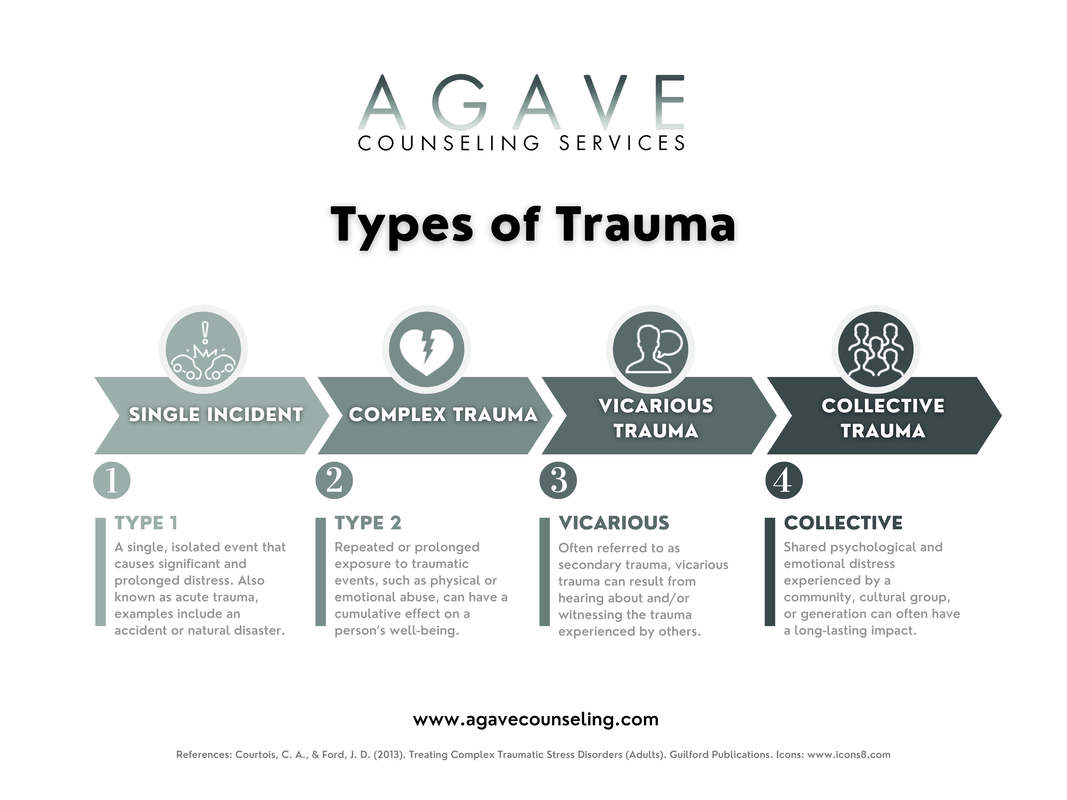
Trauma can be experienced in a number of different settings.  Whether an event is deemed traumatic is defined by the 'subjective experience' of it rather than the event itself. Trauma often is categorized into four types. 

TYPE 1
 
Often referred to as single-incident trauma which is sudden and unexpected, this trauma is limited in duration, and the individual experiences high levels of acute threat during the period of time in which the trauma occured. Examples could include severe illness, traumatic loss, an assault, witnessing violence, witnessing a disaster, combat incidents, childbirth, or other medical trauma.
 
TYPE 2
 
Type two is referred to as complex trauma which can be trauma that was experienced by an individual as being long-lasting and ongoing over a period of time. Complex trauma can include experiences in childhood or early stages of development (even in utero), as well as experiences in adolescence and/or adulthood. Examples could include neglect, domestic violence, abuse, or the witnessing of neglect, domestic violence, or abuse. Additionally, bullying, coping with a chronic illness, or faith-based trauma.
 
VICARIOUS TRAUMA
 
Trauma does not only need to be experienced by an individual, for it to be distressing. Vicarious trauma can occur when the person who has experienced a trauma or witnessed a trauma firsthand communciates that trauma to another individual. The listener can experience trauma as well as similar, if not identical, symptoms that would be experienced by the person who had experienced the trauma.
 
COLLECTIVE TRAUMA
 
This trauma is characterized by psychological or emotional difficulties which can affect different communities, cultural groups, and generations. Adaptive and maladaptive coping patterns can be passed through communities intergenerationally, often referred to as "intergenerational trauma". Examples might include discrimination, sexism, racism, slavery, natural disasters, terrorism, experiences as a refugee, genocide, and or war.

​
References

1.   Friedman, M. J., Schnurr, P. P., & Keane, T. M. (2021). Handbook of PTSD, Third Edition. Guilford Publications.
2.   Herman, Judith L. (2015). Trauma and recovery: The aftermath of violence from domestic abuse to political terror. Basic Books.

3.   Herman, Judith Lewis. (1992). Complex PTSD: A syndrome in survivors of prolonged and repeated trauma. Journal of Traumatic Stress, 3, 377–391. https://doi.org/10.1002/jts.2490050305
4.
   McCann, I. L., & Pearlman, L. A. (1990). Vicarious traumatization: A framework for understanding the psychological effects of working with victims. Journal of Traumatic Stress, 1, 131–149. https://doi.org/10.1007/bf00975140
2 Comments
cbt for trauma link
3/5/2024 06:59:14 am

Wow, this blog post is incredibly insightful! Thank you for sharing such valuable information. Your perspective has truly broadened my understanding on this topic.

Reply
Rosser link
3/6/2025 07:24:13 pm

Your comprehensive overview of the various types of trauma is both enlightening and accessible. By delineating categories such as single-incident trauma, complex trauma, vicarious trauma, and collective trauma, you provide readers with a nuanced understanding of how traumatic experiences can manifest differently. This clarity not only educates but also fosters empathy towards those affected. Thank you for shedding light on this crucial topic and promoting greater awareness.

Reply


Leave a Reply.

    Extras

    Freebies & E-Courses

    Themes

    All
    Trauma

    Recent posts

    June 2023
    May 2023
    April 2023
    March 2023
    February 2023

    RSS Feed

Proudly powered by Weebly
  • Home
  • About
  • Services
  • Rates & FAQ's
  • Blog
  • Contact